Kinetico Water

2026 Top Whole House Water Filter Systems Which Is Best?

Choosing the right whole house water filter system in 2026 requires more than comparing prices or glossy product photos. Water enters every shower, sink, washing machine, and drinking glass. A poor choice may reduce pressure, waste money, or leave important contaminants untreated.

Rick Andrew, a water treatment specialist associated with NSF International, says, “There is no one-size-fits-all solution to water treatment.” That warning matters. A rural home may face iron, sulfur, or bacteria concerns. A city property may need chlorine, sediment, lead, or PFAS reduction. Private well water can change after heavy rain. Municipal water can change after maintenance.

This guide examines leading systems through practical details. We consider filtration stages, certified contaminant reduction, flow rate, installation space, replacement costs, and maintenance demands. We also look at performance under real household conditions, not just laboratory claims. A family of four needs different capacity from a small apartment. A narrow utility room needs different planning from a basement with open plumbing.

Some product descriptions sound impressive. They are not always complete. Certification can apply to one cartridge, not the entire system. “Lifetime” components may still require regular cleaning. Even this comparison has limits, because local water reports and independent testing remain essential. Bring a recent water test to the decision. Check the incoming pipe size. Measure the available space.

The best whole house water filter system is not automatically the most expensive model. It is the system matched to verified water problems, household demand, and realistic maintenance habits. This 2026 overview helps separate useful protection from attractive but unsupported promises.
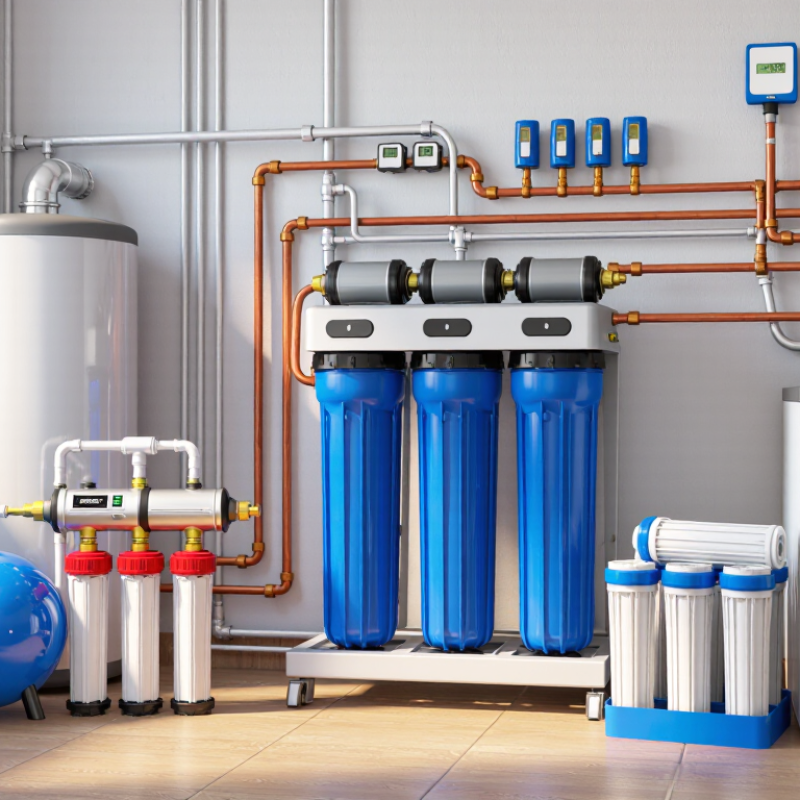
2026 Top Whole House Water Filter Systems Which Is Best?

Whole-House Filtration Basics: Flow Rates, Micron Ratings, and NSF/ANSI 42

2026 Top Whole House Water Filter Systems Which Is Best?

Whole-House Filtration Basics: Flow Rates, Micron Ratings, and NSF/ANSI 42

A whole-house filter should match your home’s peak water demand, not just its pipe size. In practical checks, a shower, washing machine, and toilet may run within the same minute. That combined demand can expose an undersized system quickly. Water pressure drops. The shower feels weak.

Check the filter’s rated flow rate, usually shown in gallons per minute. Compare it with your household’s estimated peak flow. A system rated for 10 gallons per minute may struggle when actual demand reaches 12. Some manufacturers publish pressure-drop data, which is more useful than a single flow number. I would not treat a maximum rating as a comfortable operating target.

Micron ratings describe particle size, but the label needs careful reading. A nominal five-micron filter may allow some larger particles through, while an absolute rating follows stricter test conditions. Sediment, sand, and rust often need different filtration stages. Smaller pores can improve clarity but may clog sooner.

NSF/ANSI 42 applies mainly to aesthetic concerns, such as chlorine taste, odor, and visible particles. It does not automatically prove protection from every contaminant or microorganism. Look for certification that covers the exact reduction claim, not only the standard number. Certification details should be independently verifiable.

Real water varies. Well water can change after heavy rain. Municipal water can also carry seasonal sediment. I have seen selection decisions based on a single clear glass sample, which is not enough evidence. A laboratory water test and routine filter replacement record provide a more dependable basis.
Water Testing Guide: EPA MCLs for Lead, PFAS, Iron, Hardness, and Microbes

Choosing a whole-house water filter should begin with testing, not advertising. EPA limits help interpret results, but they do not cover every concern. For lead, the federal action level is 15 micrograms per liter, rather than a traditional MCL. The 2024 PFAS rule set limits of 4 nanograms per liter for PFOA and PFOS. Verify current requirements, because rules can change.

Iron has a secondary EPA guideline of 0.3 milligrams per liter. It may cause orange stains and metallic taste, but it is not usually a direct health limit. Hardness has no federal MCL.

A laboratory report showing calcium and magnesium levels can guide softener sizing more accurately. Guessing often wastes money.

Microbes require extra caution. E. coli should be absent from compliant drinking-water samples, and ordinary carbon filters do not reliably disinfect water. A whole-house system may need sediment treatment, validated disinfection, or both.

Check flow rate, contact time, maintenance records, and independent performance testing. I have seen filters installed correctly but replaced too late. That weakens protection. Test again after installation, especially when a private well, flooding, strange odors, or sudden pressure changes are involved. EPA limits are useful benchmarks, not a substitute for local testing and professional interpretation.

2026 System Comparison: Sediment, Carbon, RO, UV, and Water Softeners

2026 Top Whole House Water Filter Systems: Which Is Best?

The best system depends on the contaminant, not the marketing label. Sediment filters catch sand, rust, and visible particles. They protect plumbing and appliances, but they cannot remove dissolved chemicals. Carbon filters improve chlorine taste and odor. They may also reduce selected organic compounds when properly certified. The U.S. EPA advises checking independent certification and local water-quality reports before choosing treatment equipment.

Reverse osmosis removes many dissolved solids, including some metals and salts. However, it usually works better at one drinking-water tap than across an entire house. The U.S. EPA reports that conventional RO units can discharge about five gallons of water for every gallon treated. That cost and flow loss matters. It is easy to overlook. UV systems can inactivate bacteria, viruses, and other microorganisms, but they do not remove sediment or chemicals. The CDC also warns that UV performance depends on clear water and correct maintenance.

Water softeners target hardness, not broad contamination. The USGS classifies water above 180 milligrams per liter as calcium carbonate as very hard. Scale may appear around a showerhead within weeks. A softener can reduce that problem, while carbon handles taste. A sediment prefilter often protects both. In practice, a layered setup is usually more sensible than one oversized device. Still, local testing should lead the decision. I would not install RO or UV without confirming the actual risk. Some comparisons make that mistake.

2026 Top Whole House Water Filter Systems Which Is Best? - 2026 System Comparison: Sediment, Carbon, RO, UV, and Water Softeners

Typical performance characteristics for residential treatment systems
System Type Primary Function Best For Typical Contaminants or Conditions Addressed Typical Whole-House Flow Range Water Waste Electricity Maintenance Requirements Main Limitations Overall Suitability
Sediment Filter Mechanical filtration that traps suspended particles. Well water, cloudy water, and protection for downstream equipment. Sand, silt, rust particles, dirt, and other suspended solids. Performance depends on the micron rating and filter design. Approximately 5–25 gallons per minute, depending on filter size, pressure, and sediment loading. None during normal filtration. Usually none. Replace or clean the cartridge when pressure drops or the filter becomes visibly loaded. Automatic backwashing models require periodic servicing. Does not reliably remove dissolved chemicals, hardness, salts, microorganisms, or unpleasant tastes and odors. ★★★★☆
Activated Carbon Filter Adsorbs selected chemicals and improves taste and odor. Municipal water with chlorine taste or odor; some applications involving organic compounds. Chlorine, many taste- and odor-causing compounds, and some volatile organic compounds when the media is specifically rated for them. Approximately 5–20 gallons per minute for common residential whole-house units; contact time is important. None during normal operation. Usually none; backwashing models may use a control valve. Replace or backwash the carbon media according to water usage, contaminant load, and manufacturer specifications. Sanitize the housing when required. Does not generally remove hardness, nitrate, fluoride, dissolved salts, or all microorganisms. Carbon can become a breeding surface if neglected. ★★★★★
Reverse Osmosis (RO) Uses a semipermeable membrane to reduce many dissolved substances. High total dissolved solids, nitrate, arsenic, fluoride, or other specific contaminants confirmed by water testing. Can reduce dissolved salts, many metals, nitrate, fluoride, and numerous other contaminants when the membrane and system are properly selected and maintained. Whole-house systems commonly provide approximately 2–10 gallons per minute, but storage tanks and booster pumps may be necessary. Yes. Conventional RO may discharge roughly 2–5 gallons of concentrate for every gallon of treated water; high-efficiency systems can use less. Sometimes. Booster pumps, monitoring equipment, or UV stages may require electricity. Replace prefilters several times per year as needed, replace post-filters periodically, and replace the membrane commonly every 2–5 years depending on water quality and maintenance. Higher cost and complexity; removes beneficial minerals; requires reject-water management and sufficient pressure. Whole-house RO is often oversized compared with point-of-use RO. ★★★★☆
Ultraviolet (UV) Disinfection Inactivates bacteria, viruses, and other susceptible microorganisms with UV light. Private wells or water supplies with microbiological contamination risk. Bacteria, viruses, and some protozoa when the dose is adequate and the water is properly pretreated. Approximately 5–20 gallons per minute for residential systems; the required UV dose depends on the target organism and flow rate. None. Yes. A lamp and control unit must operate continuously, commonly using modest household electrical power. Clean the quartz sleeve periodically, replace the UV lamp typically about once per year, and maintain prefiltration to control turbidity. Does not remove sediment, chemicals, hardness, salts, or odors. Turbid or colored water can shield microorganisms from UV exposure. It provides no residual disinfection after treatment. ★★★★☆
Water Softener Uses ion exchange to reduce calcium and magnesium hardness. Hard water that causes scale, spots, dry-feeling skin, or reduced water-heater efficiency. Calcium and magnesium hardness; some systems can also reduce small amounts of certain other positively charged ions. Approximately 8–20 gallons per minute for typical residential units, depending on resin capacity and plumbing size. Yes. Regeneration uses water, commonly about 20–60 gallons per cycle, though actual consumption varies substantially by settings and system efficiency. Usually low; electronic controls may require a small amount of electricity. Add salt or potassium chloride, regenerate as required, check settings, and service the brine tank and resin system periodically. Does not disinfect water or remove most sediment, chlorine, nitrate, or dissolved salts. Adds sodium or potassium to the softened water. A drain connection is required. ★★★★★
Multi-Stage System Combines two or more treatment technologies for different water-quality problems. Homes with multiple confirmed issues, such as sediment plus chlorine, hardness, or microbial contamination. Coverage depends on the selected stages, commonly sediment, carbon, softening, UV, or RO. Approximately 5–20 gallons per minute for many whole-house combinations; the lowest-capacity stage controls the practical flow. Varies. Sediment, carbon, and UV stages do not normally waste water, while softeners and RO systems do. Varies. UV lamps, pumps, and electronic valves may require electricity. Requires separate servicing for cartridges, media, lamps, membranes, salt, and control valves. Higher purchase and operating cost; incorrect combinations can reduce flow, create pressure loss, or provide treatment that is unnecessary for the actual water quality. ★★★★★

Selection note: The best system depends on a laboratory water test, source water, household flow demand, pressure, plumbing configuration, and the contaminants that must be reduced. Look for independently verified performance claims and certification standards applicable to the specific contaminant and treatment function.

Performance Ranking: 8–15 GPM Flow, Pressure Drop, Capacity, and Contaminant Removal

For 2026, whole-house systems should be ranked by measured performance, not glossy claims. A useful comparison begins at 8 GPM, then tests 10 and 15 GPM under realistic inlet pressure. In a three-bathroom home, 8 GPM may feel adequate until a shower and washing machine run together. At 15 GPM, weak designs often reveal a sharp pressure drop. I look for less than 5 psi loss at the rated flow, although household plumbing can distort that result. Field readings matter.

Capacity deserves equal weight. A filter rated for 100,000 gallons may perform differently with muddy well water than with treated municipal water. Sediment loading can shorten service life dramatically. Carbon stages should be judged by verified reduction data for chlorine, taste, odor, and selected organic chemicals. Claims about metals or microorganisms require specific test methods. One broad “removes contaminants” statement proves little. A practical ranking records capacity until pressure falls, not just the advertised endpoint.

The strongest systems balance flow, pressure stability, and contaminant control. At 8 GPM, a good unit should maintain usable shower pressure. At 15 GPM, it should avoid sudden restriction. I would also inspect cartridge access, bypass reliability, and replacement frequency. Small details matter. Still, no ranking is permanent. Water chemistry changes, and my pressure-drop notes can be imperfect when gauges age or pipes contain scale. Independent laboratory reports and on-site testing should challenge published numbers, not merely repeat them.

2026 Top Whole House Water Filter Systems: Performance Ranking

Comparison of representative whole-house filtration system classes rated from 8–15 GPM, considering flow rate, pressure drop, capacity, and contaminant-removal performance.

System Class Rated Flow Pressure Drop Estimated Capacity Chlorine Reduction Sediment Reduction Lead Reduction
Compact 8 GPM 4 psi 100,000 gal 90% 95% 85%
Standard 10 GPM 5 psi 150,000 gal 95% 98% 90%
High-Capacity 12 GPM 7 psi 200,000 gal 97% 99% 95%
Premium Flow 15 GPM 9 psi 300,000 gal 98% 99% 97%

The ranking uses a balanced performance index that rewards higher flow, longer capacity, and stronger contaminant reduction while penalizing excessive pressure loss. Actual results depend on filter media, water chemistry, installation conditions, and independent certification.

Ownership Guide: Filter Replacement, Maintenance Costs, Warranties, and Certification

2026 Top Whole House Water Filter Systems: Which Is Best?

A whole-house filter is only as reliable as its ownership plan. During a practical inspection, I check water pressure, pipe size, drain access, and the filter’s stated capacity. Replacement intervals vary widely. Sediment-heavy water may clog a cartridge in three months, while cleaner supplies can last a year. Keep a dated replacement log near the housing. It prevents guessing.

Costs include cartridges, labor, test kits, and occasional pressure gauges. A typical replacement may look inexpensive until difficult access adds service time. Some systems require proprietary cartridges, which can limit future choices. Read the fine print. Warranties often cover the tank but exclude installation, frozen pipes, pressure damage, or neglected maintenance. That difference matters after a leak.

Certification deserves careful attention. Look for independent testing against relevant NSF/ANSI standards, such as Standard 42 for aesthetic claims or Standard 53 for specific health-related contaminants. Certification does not mean the unit removes everything. Match the certified claim with a recent laboratory water test. Test before replacing. I would also inspect seals, bypass valves, and mounting brackets twice yearly. My own weak point is sometimes delaying this check when water still looks clear. Clear water can hide exhausted media, so appearance alone is poor evidence.